Precision Grading & Site Preparation Services
GPS-controlled motor graders and drone-assisted progress mapping for building pads, parking lots, road subgrade, and finish grading across Northern California.
Proper grading is the critical first step in any construction project, establishing the foundation elevation, drainage patterns, and structural subgrade that everything else is built upon. Walberg, Inc. provides comprehensive grading and site preparation services throughout Tehama, Butte, Shasta, Glenn, Colusa, and surrounding areas, from rough mass grading on large commercial developments to precision finish grading on building pads and parking lots. Our work ensures that your project starts on the right foundation — literally.
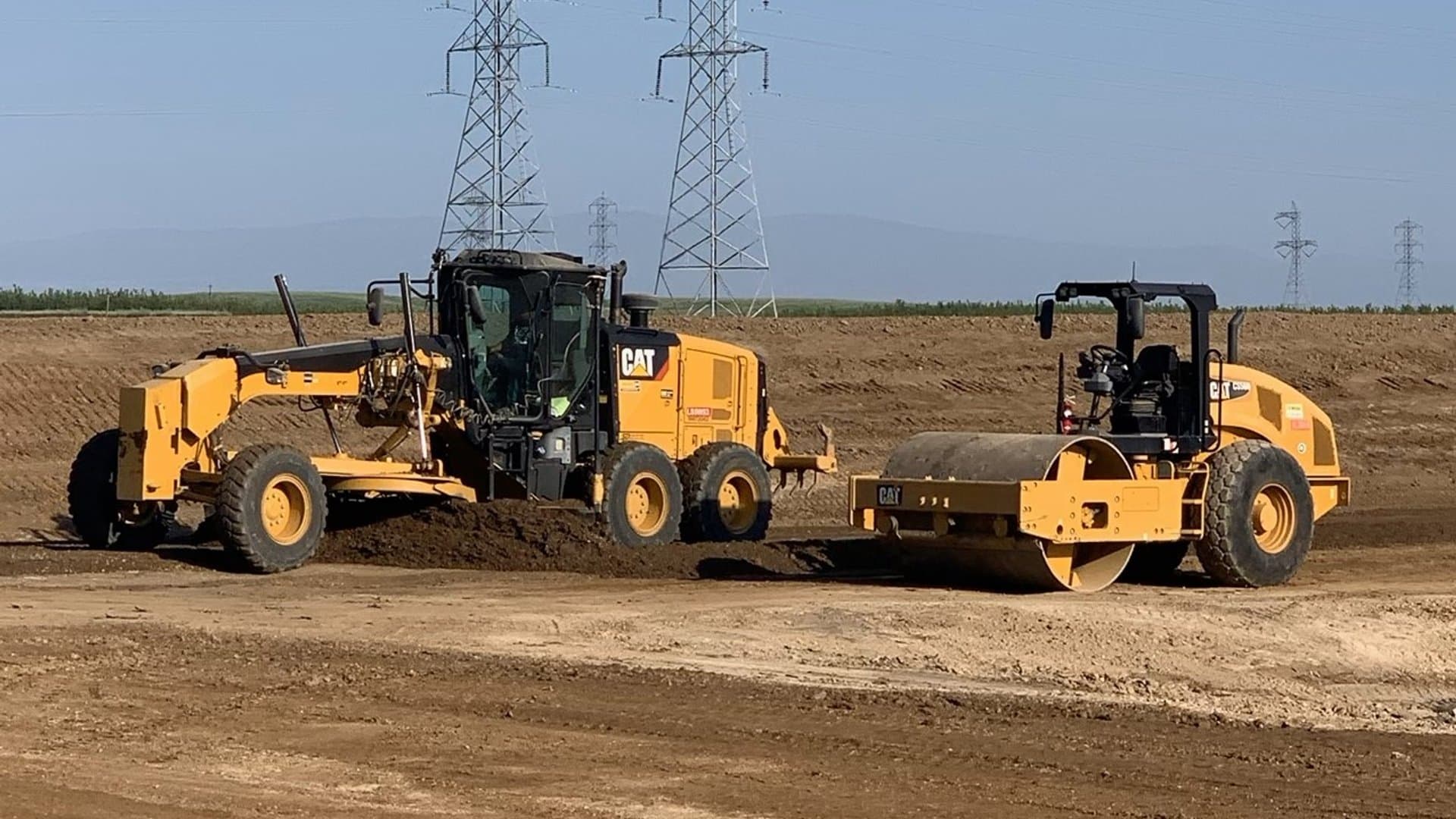
Our grading fleet features GPS-controlled motor graders that deliver consistent accuracy across every pass. By loading the engineered site plan directly into the machine's GPS system, our operators can cut and fill to precise grades without constant manual survey checks. This technology is particularly valuable on large commercial pads and parking lot projects where maintaining consistent slope and drainage across thousands of square feet is critical. We also use drone-assisted progress mapping to document earthwork quantities, verify grades at intermediate stages, and provide visual progress reports to project owners and engineers.
The grading services we provide cover the full range of site preparation needs. Rough grading establishes the general site contours, moving large volumes of earth to bring the site close to planned elevations. Fine grading refines those contours to within tenths of a foot, establishing the precise slopes and drainage patterns shown on the grading plan. Finish grading is the final step before paving, concrete, or landscaping, where we dial in tolerances to within hundredths of a foot for building pads, sidewalk subgrade, and pavement sections.
With 26 years of experience grading sites throughout the Northern Sacramento Valley, our operators understand the local soil types — from the clay-heavy soils of the valley floor to the rocky decomposed granite found in the foothills. This knowledge helps us anticipate compaction challenges, moisture content requirements, and material behavior that can affect the quality and efficiency of grading work. Combined with our fleet of over 100 pieces of company-owned heavy equipment and a crew of 38 to 40 experienced employees, Walberg, Inc. delivers grading results that meet engineered specifications on time and within budget.
What's Included
- Rough grading and mass earthwork
- Fine grading to engineered specifications
- Finish grading for building pads and parking lots
- Road subgrade preparation
- Drainage swale and ditch grading
- GPS-controlled motor grader operation
- Drone-assisted progress mapping and quantity verification
- Compaction and moisture conditioning
- Import and export of fill material
- Erosion control installation
OUR PROCESS
How we deliver grading & site preparation.
Plan Review & Site Evaluation
We review the engineered grading plan, calculate cut and fill quantities, evaluate existing site conditions and soil types, and develop a grading strategy that minimizes material import or export costs.
Survey Control & GPS Setup
We coordinate with the project surveyor to establish control points, load the digital site plan into our GPS-equipped machines, and verify calibration against known benchmarks before grading begins.
Grading Operations & Compaction
Our crews execute the grading plan in systematic phases — rough grading first, followed by fine and finish grading. Material is moisture-conditioned and compacted in lifts to meet the project geotechnical specifications. Drone surveys track progress at key milestones.
Final Grade Verification & Turnover
We verify the finished grades against the engineered plan using GPS and survey equipment, coordinate the final compaction testing, install temporary erosion control measures, and turn the site over ready for the next construction phase.
EQUIPMENT
Equipment used on this service.
AREAS SERVED
Available across Northern California.
RELATED SERVICES
Other services you might need.
FAQ
Frequently Asked Questions
Rough grading moves large volumes of earth to establish approximate site elevations and is typically accurate to within a few inches. Finish grading is the final pass that brings the surface to the precise elevations and slopes specified in the engineering plans, often within hundredths of a foot. Most projects require both phases.
Grading costs vary widely based on the volume of earth to be moved, soil conditions, and whether material needs to be imported or exported. Simple pad grading might cost $3,000 to $8,000 per acre, while complex sites with significant cut and fill can run $15,000 to $50,000 or more per acre. We provide free detailed estimates based on plan review.
Most jurisdictions in our service area require a grading permit for earthwork exceeding certain volume thresholds, typically 50 to 100 cubic yards. Projects in floodplains or near waterways may have additional permitting requirements. Walberg, Inc. can help you navigate the permitting process for your specific project and location.
We use GPS-controlled motor graders and bulldozers that reference the engineered site plan in real time, delivering sub-inch accuracy across the entire site. We supplement this with drone-assisted progress mapping and coordinate with the project surveyor for independent grade verification at key milestones.
Grading during the wet season is possible but can be more challenging and costly due to soil moisture conditions and erosion control requirements. We monitor weather closely and adjust scheduling accordingly. For time-sensitive projects, we can work in wet conditions with appropriate measures, though dry-season grading is generally more efficient.
The Northern Sacramento Valley features a range of soil types including heavy clay, sandy loam, gravelly alluvial soils, and rocky decomposed granite in the foothills. Our operators have 26 years of experience working with these local soil conditions and understand how each type behaves during grading, compaction, and moisture conditioning.